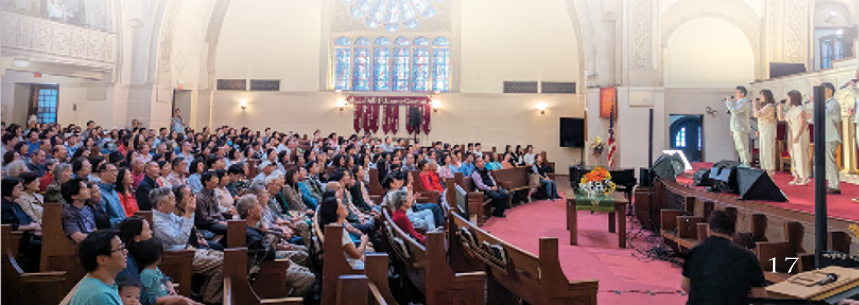
Prelude: My spiritual milestone brief today: Drawing to God for sharing His Word of grace changes my life.Three years ago, I started emailing my devotionals daily. Kim prompted my connection with Xiu-e WANG, Ying’s mother. This respectful lady published her testimony at the age of 89. There are more old and new friends here now.
After finishing the exegesis of the Book of Jeremiah, I will continue with the Book of Ezekiel. Spiritual coworkers’ prayers are of the utmost importance in cleansing the vessel for the Lord’s use (2 Tim 2:21).
Encouraging one another, confessing faults and praying for each other, this has been effective indeed (James 5:16). My son called me during the Autumn Festival, when my symptoms got better. My nightly-up time was reduced from 6-7 times to twice. I could have the prayer readings at 1-3 AM or even earlier, without unbearable pancreatic congestion sufferings. God has led me through. Last month my characteristical pain was gone, and I have notified my relatives and Bible groups to give thanks for the past decade. My Lord lavishes incredible deliverance of songs to me and all alike till this day (Ps 32:7; 51:12).
12/28/2024 God’s Love Letters to His Children (2 Tim 3:16-17; Eph 2:7, 10; 6:11; 1 Pet 1:11)
All of the Scripture is God-breathed and is useful for teaching, rebuking, correcting, and training in righteousness, so that the servant of God may be thoroughly equipped for every good work.
Teaching: positive instruction for knowing God; Rebuking: rebuke for discerning right from wrong, truth or false; Correcting: turning back to the right path; Training in righteousness; following Lord Jesus’ steps to learn righteousness; Useful: truly effective; Complete: thoroughly equipped.
Meditate: God gave His children a family letter of love – the Bible, speaking to our hearts. Through His Spirit, He breathes His mind and thoughts into the Bible authors. We the readers try to find out how the Spirit of Christ in the authors gave His Words and predicted the sufferings of the Messiah and the glories that would follow (1 Pet 1:11). Full of our Father’s love and the most meaningful instruction: in the coming ages he might show His incomparable rich grace, expressed in His kindness to us in Christ. (Eph 2:7).
(Bible in One Year: Revelation 5-8)
12/27/2024Daily Reading in Prayer Deepening Faith in Christ (Matt 16:5-17; Mark 7:7; 4:40; Isaiah 29:13; 2 Tim 3:16; Ps 87:7; Isa 12:3)
Take heed and beware of men’s teachings, because men’s teachings block the knowledge of Christ. Walk by faith but not by sight, and only put your faith on Christ. Beware of the hypocritical and pragmatic teachings (Matt 16:5-12).
Because this people draw near with their mouth and honor me with their lips, while their hearts are far from me, and their fear of me is a commandment taught by men (Isa 29:13). The Lord said, in vain do they worship me, teaching as doctrines the commandments of men (Mark 7:7).
Meditate: The FatherGod revealed Christ. Nobody could know Christ without God’s revelations (Matt 16:13-17). Jesus says, why are you so afraid? Do you still have no faith (Mark 4:40)? Lord, teach me not to look at the environment, nor see people, nor from my perspective, not to honor men. Focus on Christ, and read the Scripture in prayer daily, which is inspired by God (2 Tim 3:16). All my springs are in you (Ps 87:7). With joy we will take water from the fountain of salvation (Isa 12:3).
(Bible in One Year: Revelation 1-4)
12/26/2024Lord Christ Is the Living God (Matt16:13-17; John 1:1; 5:58; 14:6)
Lord Christ is the living God (Matt 16:13-17). Jesus asked His disciples: “who do people say the Son of Man is?” They replied, “Some say John the Baptist; others say Elijah; and still others, Jeremiah or one of the prophets”.He was asking, what about you? Who do you say I am? Simon Peter answered, “You are the Messiah, the Son of the living God”.Jesus replied, Blessed are you, Simon son of Jonah, for this was not revealed to you by flesh and blood, but by my Father in heaven (Matt 16:13-17). Messiah, Christ anointed as the King and the Priest; the Son of the living God is the same in nature and glory as the living God.
“Very truly I tell you, before Abraham was born, I am!I am the way and the truth and the life. No one comes to the Father except through me” (John 8:58; 14:6).
Meditate: Knowing the Lord is the living God; He was in the beginning with God and all things were made through Him (John 1:1). He came to the world for love and died as ransom on the Cross for us. Lord, teach me how to respond to your love and sacrifice.
(Bible in One Year: 2 John, 3 John, Jude)
12/25/2024Triune God Lavishes Abundant Blessings in Unfailing Love (Ro 11:33-36; 1 John 4:14, 15:5; Mark 10:45; 1 Cor 12:7-11)
Triune God lavishes unfailing love with abundant blessings; for everything under heaven belongs to Him (Job 41:11). The Father sent His Son to be the Savior of the world (1 John 4:14).Jesus came to die on the Cross as the ransom for many. Everyone who believes in Him will receive eternal life (Mark 10:45; John 3:14-15). After His death and ascension, the Son and Father sent the Holy Spirit to dwell in us. Apart from Him, we can do nothing (John 16:7; 14:16:15:5).
The Holy Spirit gives everyone spiritual blessings for serving God’s household (Eph 1:3; 1 Cor.12:7).
Meditate: Lord, teach me to love you more and love your beloved, build up one another to bear much spiritual fruit (Gal 5:22-23). Oh, the depth of the riches of the wisdom and knowledge of God! How unsearchable are His judgments, and His paths are beyond tracing out! Who has known His mind? Or who has been His counselor? Who has ever given to God, that God should repay? For from Him and through Him and for Him are all things. To Him be the glory forever! Amen (Ro 11:33-36). Merry Christmas with Love and Blessings!
(Bible in One Year: 1 John 1-5)
12/24/2024Return God’s Love Generous Offerings (Matt 1:18-38; Luke 2:1-20; Romans 12:1)
Mary obeyed God and offered her body to be the Savior’s birth home. Joseph offered his love and careful protection of Mary and Holy Baby Jesus. Both parents of the Holy Baby took great risks for their reputation and physical conditions (Matt 1:18-25, 35-58).
Angels announced the good news of Messiah’s birth to the shepherds. A heavenly host of angels offered the praise to God blessing mankind. Shepherds rapidly shared the good news about Holy Baby around. The wise men gave the Holy Baby gifts worthy of royalty (Luke 2:1-21).
Meditate: We believers who worship our Savior are called to follow the Lord in thanksgiving, to offer ourselves as a whole person as a living sacrifice to Him, and to serve one another with love, for this is holy and pleasing to God and it is our true and proper worship (Ro 12:1). Learn to offer gifts like the first time of Christmas. After all, the Savior Christ is the greatest gift for mankind from our heavenly Father God. Silent Night Holy Night (https://youtu.be/sifQpiViCYM)
(Bible in One Year: 2 Peter 1-3)
12/19/2024 Know in Whom I Believe Honor Him Save Souls (2 Tim 1:6-12; 2 Cor. 9:16; Jeremiah 20:7-9)
We have a genuine faith and a strong spirit, because God’s power enables us to suffer for the gospel (v 5-12). The gospel proves that salvation is not based on our own works but on God’s grace, revealing the immortal life (v.8-9). The Lord appointed men to preach the gospel and will keep them committed to Him (v11-12).
Meditate: Obey God to share the gospel; the outcome is in His hands. Co-work with God is most important. Woe is to me if I do not (2 Cor. 9:16). Prophet Jeremiah kept preaching God’s prophecies for over 40 years, as the first to proclaim the New Testament, even persecuted by his colleague priests and relatives who tried to murder him to stop his preaching God’s warnings. He felt that no preaching was far worse, like shutting up the fire in his bones. He pleaded, and God answered: the future will be even harder, promised His presence to keep him (Jer. 20:7-9). Listen to the hymn: Know Who I Believe In (https://youtu.be/VDyGxVq8vyI).
(Bible in One Year: Hebrews 7-9)
About the Author: Anna belongs to both the Love and Quincy fellowships, and serves on the Isaiah, Jeremiah, and Ezekiel teams of the Bible Study Information Network.
在電影“瞬息全宇宙”(Everything Everywhere All at Once)中,男女主角(楊紫瓊和關繼威)代表了離鄉背井的華人面對生計的艱難(開洗衣店辛苦的工作,還被國稅局懷疑逃漏稅),婚姻經過歲月的消磨已經貌合神離,甚至面臨離婚的可能。同時,家庭中上有生重病、不能自主的父親要照顧,下要面對女兒有同性戀傾向的震憾。同樣身為海外華人的我們,雖然每個人的背景和特質不同,也常常發現多多少少都面對類似的生活困境,對電影中的故事應該會感同身受。其實這又何嘗不是普世人⸺不管是海外或本鄉的華人、或是哪一個族群的人⸺共同的經歷呢?人生都是在面對許多內在外在不同的困境;有時候這些困境壓得我們喘不過氣來;有時候我們的生活好像在搭過山車(雲霄飛車)似地起起伏伏。外在的困境以外,人生還會遭遇內在的困境⸺在平順甚至成功後心靈卻仍然在孤寂、憂懼之中。
As our church anniversary approached, I found myself reflecting on our church against the backdrop of the pretty divided world that we live in. One word kept coming to mind and weighing heavily on my heart: Unity.
We regularly pray for unity. It shapes how we do ministry and is deeply embedded in our church’s culture. We often say that unity is not uniformity, but there is unity in diversity. But this reflection also made me wonder, “Do I really know what unity is?”
There’s a psychological phenomenon called “semantic satiation”. It’s when a word is repeated so often that it temporarily loses its meaning and starts to sound strange. This happens because our brains become desensitized to the word through repetition. Am I doing that now? Unity. Unity. Unity. All in all, that’s 8 times I’ve said this word already. It feels a little strange. But I would also ask, “Could this happen to us as a church?” Could our talk of unity become so familiar that, for a moment, we forget what it truly means and how it should be lived out?
We are a diverse church even if that diversity may not always be so obvious to others. We are multilingual, multi-congregational, multicultural, and multi-generational. But what does it mean for us to have unity in our diversity? What holds us together in a way that reflects the unity that God calls us to as His church? As we celebrate and exercise our freedom in our diversity, what actually unites us?
The title of this article is You Can’t Spell Unity Without U n’ I. You and I. We’re going to unpack what that means. And we’re going to see three things in our passage. The starting point for unity. The substance of unity. And the steps to unity.
The starting point for unity is our shared experience of the gospel (v. 1)
There’s a central command at the heart of this passage. “Complete my joy,” which is explained as being of the same mind. Being united. But that is preceded by verse 1, “…if there is any [of these things].” But Paul writes presupposing these things are already true.
A more functional translation would be “Since there is encouragement in Christ, since there is comfort from love from God, since there is participation in the Spirit, since there is affection and sympathy for me as I have for you, complete my joy.”
And so before Paul instructs the church in Philippi to be united, he begins with their shared experience of these things. The starting point for unity is our shared experience of the gospel. He appeals to their common experience of the gospel. Encouragement in Christ. Comfort from love, presumably from God the Father. And participation in the Spirit. Together we have the triune God. In the gospel, you have all experienced these things from Him. And He adds a fourth thing that they have experienced. Affection and sympathy, presumably towards Him and Him towards them.
And so the message is this: Be to each other what God has been to each of you. Our shared experience of the gospel is the best starting point for unity because it equalizes us, it connects us together, and it encourages us to be to each other what God in Christ has been to each of us.
I like what J. Alec Motyer says,
[U]nity…belongs to the very essence of Christian life, for it is the way in which Christians display outwardly what the gospel is and means to them. Unity is the gospel’s hallmark; it says to all who examine it, ‘This life is worthy of the gospel.’ (The Message of Philippians, 102)
The starting point for unity is our shared experience of the gospel. But what exactly is unity?
The substance of unity is our shared mindset in Christ (v. 2)
Unity is being of the same mind. Mindset is maybe a better word. Unity is not having the same opinions about everything. That would be uniformity. Unity is not about always agreeing without exception and complete agreement. That would be unanimity. But unity is about having the same mindset – one that is shaped by the gospel, grounded in love, and focused on the same mission. It’s about being aligned in purpose, even when we differ in perspective, allowing our shared faith and commitment to Christ to guide us forward together. And in verse 5, Paul qualifies this mindset as being a mindset in the Lord. So what is unity not then?
Unity is not having a common history.
Unity is not sharing a building.
Unity is not having a joint service that 2 out of 3 congregations attend.
Unity is not having the same ethnic heritage.
Unity is not speaking the same language.
All of these things are good and they help build up our church, but I don’t believe this is what Paul is talking about when he calls us to have the same mindset in the Lord. He’s not focused on these kinds of commonalities.
Because let me tell you, even in my own home, we don’t have “unity” in the words we use every day. I’m Taiwanese American, and my wife is Fuzhounese. She speaks Mandarin and I “speak” Mandarin. But, when we raise our kids together, is it going to be gōngkè or zuòyè for the word “homework”? Is it lèsè or lājī for the word “trash”? Fānqié or xīhóngshì for “tomato”? She’s also lived in New York. I’m from Boston. Is it the T or is the subway? I say “wicked.” She doesn’t.
Even in the context of our family, we don’t always use the same words. But that doesn’t mean we aren’t united. There’s a deeper unity that comes from having the same mindset about what really matters. There is unity in our mindset that we hope for our sons to know Mandarin and to connect with their heritage specifically through language. It’s this same mindset, shared conviction, and common priority that allows us to continue forward together even as we might use different terms. I have to learn to be okay with my son saying lājī instead of lèsè. He’s still young, so there’s still hope for gōngkè.
So, unity as a mindset in the Lord is about identifying the shared convictions that are most primary to the gospel and then allowing those convictions to help us navigate our competing values. Shared convictions. Competing values. Let me explain.
In our church, some prefer traditional hymns, while others prefer contemporary praise. These are competing values that show up when it comes to decisions about how we worship together. But if we share the same mindset in the Lord, the same conviction that worship is ultimately about glorifying God, we can appreciate different approaches, even if they aren’t our personal preference, because we all believe it is about the heart of worship, not the style.
When I was serving at my former church, there was a disagreement among our leaders over whether to cover the retreat cost for the spouse of a youth counselor. So not the actual volunteer, but their spouse. One side said, “We should cover the spouse. We’re taking away the youth counselor from their family for that weekend. They just got married. The least we can do is bring the spouse along.” The other side said, “No. If we’re paying, they’re serving.” Now, fortunately, it wasn’t a big disagreement. We resolved it within a few minutes and no one left the church. But, it reflected a difference in values, right? One side valued pastoral care and appreciation more, wanting to support the counselor and show that the church cares about the family needs of its volunteers through this specific way. Another side valued service and ministry responsibility more.
Here’s the most important thing. Don’t miss this. Both sides valued all these things. They just ranked them differently, which led to this disagreement. But both sides also shared the same conviction and mindset of being good stewards of God’s resources and they believed that for each other. They did not say “Our way is good stewardship of money and your way isn’t.” They believed “We’re both being good stewards of money. We just have a different approach because of our competing values.” But that allowed them to navigate their differences, come to a resolution, and move forward in unity, even though they had differing perspectives.
But you might be thinking, “Pastor Jeff, competing values still compete. We still need to make a decision. What happens when there is no middle ground? How do we actually move forward in unity when we have to choose one option over the other? How does having the same mindset actually help us when our option isn’t chosen?” Paul unpacks what this mindset means in verses 3-4 and verses 5-11.
The steps to unity are our shared concerns for one another (vv. 3-4)
Paul continues on.
3 Do nothing from selfish ambition or conceit, but in humility count others more significant than yourselves. 4 Let each of you look not only to his own interests, but also to the interests of others.
Unity is natural to the gospel, but it does not come naturally to us. You know what does come naturally? Selfish ambition. Conceit. Looking at our own interests, rather than the interests of others. The opposite of the mind of Christ.
Paul instead highlights humility. Humility creates unity. There is the saying, “Humility is not thinking less of yourself, but thinking of yourself less.” When Paul says to count others more significant than yourselves, he’s not saying to think, “They’re so much better than me,” but he’s saying to look to their concerns, their needs, their interests, and their values.
When we grumble and dispute, we hinder our ability to advance the gospel. Fast forward to 2:14-15.
14 Do all things without grumbling or disputing, 15 that you may be blameless and innocent, children of God without blemish in the midst of a crooked and twisted generation, among whom you shine as lights in the world,
When Paul talks about grumbling and disputing, who in the Bible does that remind you of? The Israelites! Grumbling and disputing in the wilderness. Paul says, “complete my joy by being of the same mind and furthering the gospel, but to do that you need to get your act together, stop the grumbling and disputing, and come to a common mindset about life together in Christ and show that same love for one another.” Because the truth is that we can be together and still be divided.
Let me show you what I mean. I brought with me a piece of a car windshield. And this windshield has some spider cracks in the glass. They’re small, but maybe you can still see them. The cracks compromise the integrity of the whole windshield even though it’s all still together. And sometimes there is more disunity and more disagreement (represented by this hammer) that causes these cracks to grow and spread. To the point where you can’t see clearly through the windshield anymore.
In the same way, the more divided the church becomes, the harder it is for people to see Jesus clearly through us. And also, in the same way, it’s a sobering reality when, like a spider crack, we can be together and still be divided. And eventually that will give way. It will be easier to demolish in days what took decades to build.
So what do we need? A mindset that is ours in Christ Jesus, who perfectly models what it means to look to the interests of others.
5 Have this mind among yourselves, which is yours in Christ Jesus, 6 who, though he was in the form of God, did not count equality with God a thing to be grasped, 7 but emptied himself, by taking the form of a servant, being born in the likeness of men. 8 And being found in human form, he humbled himself by becoming obedient to the point of death, even death on a cross.
In a world where it is all about my right – my right to independence, my right to my body, my right to comfort, my right to privacy, my right to retaliate, my right to my need—Jesus shows us a mindset and a way where he gives up his right to serve us, putting our needs above His own. And he calls us to have that same mindset for each other. To live that same way.
The steps to unity are our shared concerns for each other. There is the saying, “Love begins when someone else’s needs are more important than my own.” Jesus perfectly demonstrates this for us and he calls us to be united by having the same mindset. We do this easily for our children, putting their needs above our own. But God is calling us to do it not for our children, but for those whom we call brother and sister in Christ.
What does it mean for a multilingual, multi-congregational, multicultural, and multi-generational church like ours? Could we be united in a shared mindset in Christ that seeks the interests of other congregations and generations?
Do you know that City Light sometimes get overlooked because they meet in Boston and not in Lexington? Do you know that CM is a fairly large congregation? And because of its size, it can be challenging to meet the many diverse needs that smaller congregations might not face as intensely. Do you know that Cross Bridge doesn’t benefit from the same economies of scale and struggles with having enough human resources to meet its own needs while also supporting other larger churchwide ministries? Do you know that the youth are still meeting in the same closets that I met in when I was a youth 20 years ago? And they still keep getting kicked around to make room for the rest of us. And now I’m part of the problem. Do you know that children’s ministry coworkers go months without worshipping upstairs? And some of them would love for the program to have a one month break in July for their coworkers.
The steps to unity are our shared concerns for one another. What if we looked not only to our own interests, but also to the interests of others? How powerful would it be if CB and CM said “We might need our space, but we will give up our right to that space so the youth can have it.” How amazing would it be if CB and CM said “We’re going to give Mustard Seed coworkers a break for one month. And we’re going to invite those young kids into our worship services and for just four Sundays, our parents will figure out how to worship with their kids.” We may not always find an easy solution, but being aligned in mindset and purpose and fighting for each other is far better than fighting with each other.
Earlier this year, I went over this with the leaders in Cross Bridge. I call it the ABCs of Leadership in a Chinese Heritage Church (see What is a Chinese Heritage Church?).
Actually, we might even call it the ABCs of Leadership for ABCs (American-born Chinese) in a Chinese Heritage Church, since I was speaking to CB leaders. But, I believe, in light of Philippians 2:1-4, that this might be helpful not just for CB leaders, but also for all of us as we demonstrate our shared concerns for one another.
A stands for Advocate. Speaking up and advocating for each other’s needs, whether that is a particular congregation, generation, demographic, person, etc. B stands for Bridge. Connecting with others across generational and cultural gaps and figuring out how to bridge those gaps. Part of it is identifying both the shared convictions and the competing values, but then finding a way forward that honors those different values. C stands for Comprehend. Understanding the people and what the needs and contexts are, especially those shared convictions and competing values.
If we can bridge and comprehend, but don’t advocate, there’s no change. Nothing will happen because no one will say anything. If we can advocate and comprehend, but don’t bridge, there’s no buy-in. There may be change, but at the cost of relationships. If we can advocate and bridge, but don’t comprehend, there’s no purpose. We suggest solutions that don’t make sense. We risk taking the church in a different direction or bringing about unforeseen consequences, because we don’t really understand the people, the needs, or the context. So we need to be able to advocate, bridge, and comprehend together.
And the foundation that undergirds this entire framework is “trust.” Trust in God and trust in each other as we do these ABCs.
Without trust, advocacy will feel self-serving. “You’re just bringing this up to benefit yourself.” Without trust, bridging will feel fragile. “I don’t really know you and you don’t really know me.” Without trust, comprehending will feel shallow. “You don’t actually understand my needs.”
The three points from Phillippians 2:1-4 are this.
The starting point for unity is our shared experience of the gospel (v. 1)
The substance of unity is our shared mindset in Christ (v. 2)
The steps to unity is our shared concerns for one another (vv. 3-4)
And if every member and leader embodied all three, what a powerful picture of church unity in our diversity that would be. Because remember, you can’t spell unity without U n’ I.
About the author: Jeff is the pastor of the Cross Bridge Ministry – an English ministry at CBCGB. This sermon was originally delivered as the sermon during the Church’s joint 55th Anniversary Service and has been edited for clarity, grammar, and readability in print.
You are worthy, our Lord and God, to receive glory, honor, and power; for You created all things, and by Your will, they were created and have their being. We are blessed to be Your people, Your children, Your beloved. Our hearts desire to come before Your throne of grace, to be drawn to Your majesty and beauty. May You be glorified through our praises this morning and satisfy our hearts through worship. In Jesus’ name, Amen.